
YouTube Shorts vs Instagram Reels: Which Grows Your Brand
Confused between YouTube Shorts and Instagram Reels? Discover which platform wins for awareness, trust, leads, and monetization — and how to run both.
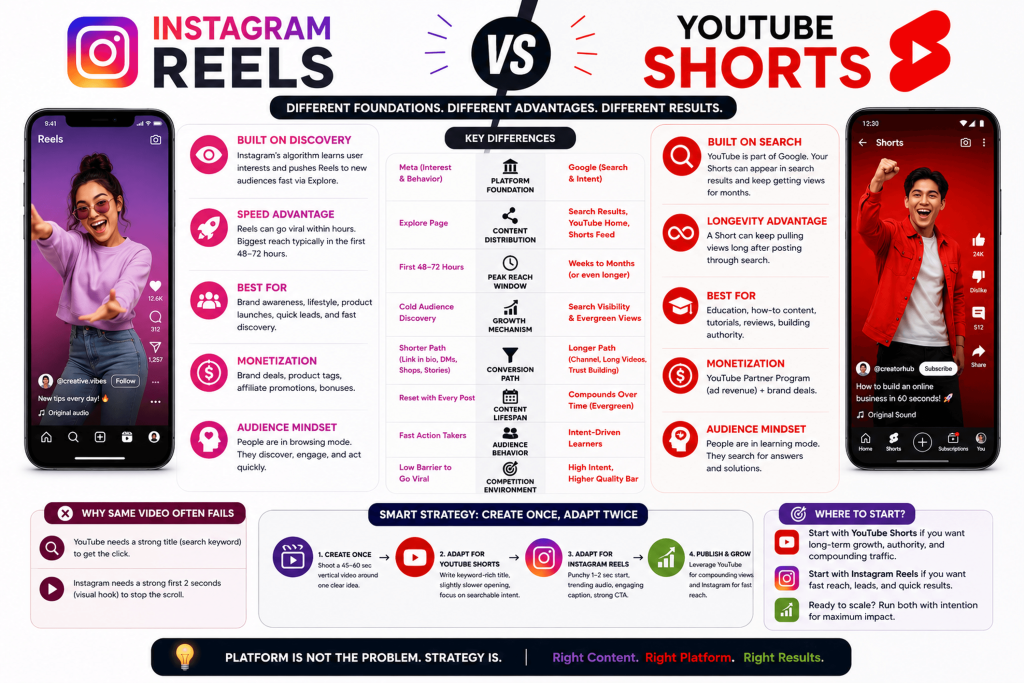
YouTube Shorts vs Instagram Reels: Which One Actually Grows Your Brand
Most marketers treat YouTube Shorts and Instagram Reels like they are the same thing in different packaging. Same video length, same vertical format, same scroll-and-watch behavior. So they either pick one randomly, or post identical content on both and wonder why results stay flat.
The truth is these two platforms are built on completely different foundations. What works brilliantly on one can fall completely flat on the other. The real question isn’t which platform is better. The answer depends entirely on what your current goals demand.
Two Platforms, Two Different Internets
Before choosing a platform, you need to understand what each one is actually built on because the difference runs much deeper than audience size or aesthetics.
YouTube Shorts runs on Google. That one fact changes everything. When someone opens Google and types a question, a Short can appear as the answer. Your video isn’t competing only inside YouTube. It’s competing inside the world’s largest search engine. A Short you upload today can pull in views three, six, even twelve months from now, not because it went viral, but because people never stop searching for the topic you covered.
Instagram Reels runs on interest and behavior. Meta’s algorithm studies what people watch, pause on, replay, and engage with, then serves them more of it. The Explore page is one of the most powerful cold audience tools in social media right now. A single Reel can land in front of thousands of people who have never heard of you, within hours of posting. But that window closes fast. Most Reels see their biggest reach in the first 48 to 72 hours, then visibility drops sharply.
One platform gives you longevity through search. The other gives you speed through discovery. Understanding which you need right now is the whole game.
Which Platform Wins at Each Stage of Growth?
Awareness
If you are a new brand trying to get in front of cold audiences fast, Instagram Reels wins. The Explore page does the heavy lifting. You don’t need followers to reach people. The algorithm will push your content to relevant users based on interest signals alone. YouTube Shorts can build awareness too, but it works better once people are already searching for your topic. If no one knows your category exists yet, search won’t save you.
Trust and Authority
This is where YouTube Shorts dominates. Delivering a precise answer to a user’s query positions you as a credible authority — and doing that repeatedly across multiple topics builds a reputation that compounds over time. Instagram can build trust too, but it resets with every post. There is no searchable archive working for you in the background.
Lead Generation
Instagram Reels wins here. The path from video to action is shorter. Link in bio, DMs, product tags, and story swipe ups all sit within the same app. Instagram users are conditioned to discover something and act on it immediately. YouTube’s lead generation path is longer and requires more deliberate funnel building.
Education and Course Marketing
YouTube Shorts is purpose built for this. People arrive on YouTube with intent. They are already looking for an answer, a how to, or an explanation. If your content solves a specific problem in 60 seconds, viewers trust you enough to explore your channel, watch longer videos, and eventually invest in your courses or services. Instagram viewers aren’t in learning mode. They’re in browsing mode.
Monetization
YouTube Shorts wins clearly. After reaching the Partner Program requirements, your videos begin generating ad income without any ongoing effort on your part. Instagram’s monetization relies almost entirely on brand partnerships, which take time, audience size, and ongoing negotiation to build. Among content platforms, YouTube stands out as the most efficient route to earning hands-off revenue.
Why the Same Video Fails on One Platform and Thrives on the Other
The biggest mistake creators make is posting the exact same content, with the exact same framing, on both platforms simultaneously. The mechanics of success are fundamentally different.
On YouTube Shorts, your title is the hook. Before a single frame plays, a viewer has already decided whether to watch based on what your title promises. Structure your wording to mirror how your audience naturally phrases their online searches. Be specific. Be direct. A title like “Why your Instagram reach dropped in 2025” will consistently outperform “Tips to grow on social media” not because it’s more interesting, but because it matches real search behavior. Use Google Trends to find the exact language your audience uses, and build your title around that.
On Instagram Reels, your first two seconds are the hook. There is no title. There is no preview. There is only what’s on screen in that opening moment. If it doesn’t stop the scroll, the video is already over. Start with something visually unexpected, emotionally sharp, or immediately useful. Incorporating popular audio tracks can significantly increase your Reels’ visibility, since the platform tends to favor content featuring widely-used sounds. Write a caption that either adds depth or invites a response. And always include captions in the video itself, because the majority of viewers watch without sound.
One more principle that applies to both: consistency always beats frequency. Posting three focused, well crafted videos a week with a clear strategy will outperform posting every day without one. Pick a content direction, stick with it long enough to build an audience around it, and let the data tell you what’s resonating.
You Don’t Have to Choose. Here’s How to Run Both Smartly.
The best short form creators aren’t choosing between platforms. They’re building a simple system that feeds both from a single piece of content.
Shoot one strong 45 to 60 second vertical video built around a clear, specific idea. Not a broad topic. One question, one insight, one tip taken all the way. Then adapt it for each platform separately.
For YouTube Shorts, write a keyword rich title that mirrors how your target audience searches. The opening of the video can be slightly slower because viewers already committed by clicking. They know what they’re here for.
For Instagram Reels, recut the opening so it punches in the first two seconds. Layer in trending audio. Write a caption that either extends the point or asks a question that invites comments. Add a low pressure call to action that fits naturally.
Same core content. Different packaging. You get the compounding SEO power of YouTube and the fast discovery reach of Instagram from one video, with roughly twenty extra minutes of work per post.
So Where Should You Actually Start?
If you are building a personal brand, establishing authority in a niche, or selling through education, start with YouTube Shorts. The search visibility compounds over time. Every video you post keeps working for you long after you have moved on to creating the next one. The audience you build is slower to grow but significantly more loyal.
If you are launching a product, building a lifestyle brand, or needing leads quickly, start with Instagram Reels. The Explore page can introduce your brand to thousands of potential customers in a single day. The audience is ready to discover and act.
If you are past the starting phase and want both reach and authority, run both intentionally. Not the same post copy pasted twice, but the same core content adapted for how each platform actually rewards its creators.
The platform has never been the problem. The strategy is what separates creators who grow from those who just post and wait.
At OMiT, we don’t just teach digital marketing concepts. We show you how to apply them. From short form video strategy to full funnel campaigns, our courses are built for people who want real, measurable results. Visit omit.in to find the right course for where you are right now.
By:Mohammed Danish