
The Privacy Paradox: Why Consumers Want Personalised Ads but Hate Being Tracked?
Imagine searching for a pair of shoes online and, a few minutes later, seeing those same shoes on Instagram, YouTube, and almost every website you visit. At first, it feels convenient. The advertisement is relevant, timely, and perhaps even tempting. But then comes the uncomfortable thought:
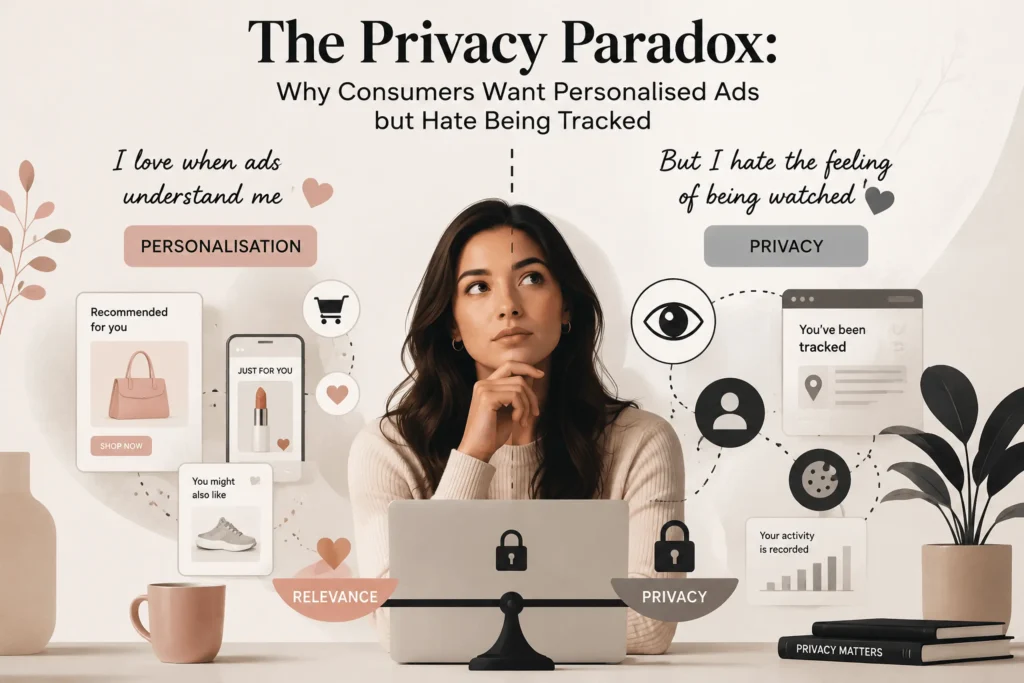
How does this brand know I was looking at that?
This is the heart of the privacy paradox in modern digital marketing. Consumers want brands to understand their interests and show them relevant content, but they also want control over how their information is collected and used. In other words, people want the benefits of personalisation without feeling like they are being watched. As digital marketing becomes increasingly dependent on data, the relationship between personalisation, privacy, and consumer trust has become more important than ever.
Why Is Data Important in Digital Marketing?
Data is one of the most valuable resources for any marketer in the modern society . Every time we search for something online, visit a website, purchase a product, watch a video, click an advertisement, or interact with an email, we create information that can potentially help businesses understand our behaviour.
Marketers may use data such as:
- Search history
- Website visits
- Purchase behaviour
- Location
- Age and interests
- Social media activity
- Email engagement
- Products added to a shopping cart
This information helps brands understand their customers and create more relevant advertisements, products, and experiences. For example, if an online fashion store notices that a customer regularly searches for ethnic wear, the brand can use that information to recommend similar products. Instead of showing completely random advertisements, the customer may see products that are more likely to match their interests. This makes marketing more efficient for businesses and potentially more useful for consumers. But the question is not simply whether businesses can collect data.
The more important question is:
Should they collect all the data they possibly can?
Why Do Consumers Love Personalisation?
Digital advertising has changed dramatically over the years. Instead of showing the same advertisement to everyone, brands can use consumer data to understand preferences, interests, and behaviours.
Think about the difference between these two advertisements:
“Buy our new skincare collection.”
and
“Looking for a lightweight moisturiser for combination skin? Try our new collection.”
The second advertisement feels more useful because it speaks directly to a potential need.
This is the power of personalised advertising. When done responsibly, personalisation can reduce irrelevant advertisements, make online experiences more convenient, and help consumers discover products they genuinely care about. Streaming platforms recommend movies based on what we watch. Shopping websites recommend products based on what we browse. Music applications suggest songs based on our listening habits. Consumers often enjoy these experiences because they save time and make technology feel more useful. The problem begins when personalisation becomes too personal.
When Personalisation Starts Feeling Like Surveillance.
There is a fine line between:
“This advertisement is useful.”
and:
“How does this company know this about me?”
Every search, click, purchase, video watched, and website interaction can potentially contribute to a digital profile. Online tracking technologies can help advertisers understand user behaviour and deliver more relevant advertisements. From a marketer’s perspective, this information can be incredibly valuable. It can help businesses understand their audiences, measure advertising campaigns, identify trends, and predict consumer interests. From a consumer’s perspective, however, the same technology can sometimes feel invasive. The issue isn’t necessarily that people don’t want their data used. Often, they simply don’t understand what is being collected, why it is being collected, who can access it, or how long it will be retained. And when people don’t understand what is happening behind the screen, trust begins to disappear.
The Privacy Paradox
This creates a fascinating contradiction. Consumers often say they care deeply about digital privacy, yet they willingly share information online every day. They may accept cookies, use personalised recommendations, allow applications to access certain information, create social media profiles, shop online, and interact with targeted advertisements. At the same time, those same consumers may feel uncomfortable when advertising becomes noticeably specific.
This is known as the privacy paradox:
We want brands to know enough about us to make our digital experiences better—but not so much that we feel exposed.
For example, a consumer may happily provide their email address to receive a discount from a clothing brand. However, they may become uncomfortable if they discover that their online activity is being tracked across multiple websites.
The challenge for marketers is finding that invisible boundary between relevance and intrusion.
The Role of Cookies and Online Tracking
Cookies have traditionally played an important role in digital marketing. A cookie is a small piece of information stored by a website in a user’s browser. Cookies can help websites remember preferences, keep users logged in, understand website activity, and measure advertising performance. For marketers, tracking technologies can provide valuable insights into how people interact with websites and advertisements. However, consumers have become increasingly aware that online activity can be tracked. This has led to greater demand for transparency and control. This is why users often encounter cookie banners and privacy settings when visiting websites.
The important issue is not simply whether tracking exists. It is whether consumers understand and have meaningful choices about it.
First-Party Data and the Future of Marketing
As privacy expectations continue to grow, businesses are increasingly focusing on first-party data. First-party data is information that a company collects directly from its own customers, such as purchase history, website interactions, customer feedback, or information voluntarily provided through forms. For example, a clothing brand may ask customers what types of clothing they prefer when they sign up for its newsletter. This creates a more direct relationship between the customer and the brand.
Instead of relying heavily on hidden tracking, businesses can encourage customers to voluntarily share information in exchange for something valuable, such as personalised recommendations, discounts, loyalty benefits, or better services. This can create a healthier relationship between data and personalisation.
Data Is Powerful—But Trust Is More Valuable
For years, marketers have focused on collecting more consumer data. But the future of digital marketing may depend less on how much information a brand can collect and more on how responsibly it uses the information people provide. Consumers are becoming increasingly aware of privacy. They want transparency. They want meaningful choices. And most importantly, they want to feel respected. This is where ethical personalised advertising becomes important.
A trustworthy brand doesn’t simply ask:
“What information can we collect?”
It asks:
“What information do we actually need?”
That difference may define the next generation of digital marketing. A brand that protects customer information can build a stronger relationship with its audience. On the other hand, a company that misuses personal information can quickly lose customer confidence. In the digital world, trust can be difficult to earn and extremely easy to lose.
Privacy Regulations and Consumer Rights
Growing concerns about personal information have led governments around the world to introduce privacy regulations. Regulations such as the General Data Protection Regulation (GDPR) in the European Union, the California Consumer Privacy Act (CCPA) in California, and India’s Digital Personal Data Protection framework aim to strengthen privacy protections and give individuals greater control over their personal information.
For digital marketers, privacy regulations mean that data cannot simply be treated as a limitless resource. Businesses need to consider issues such as transparency, consent, security, responsible data handling, and consumer rights. This has changed the role of marketers.
A successful marketer today needs to understand not only how to attract customers, but also how to handle customer information responsibly.
How Can Marketers Respect Privacy?
Businesses can build trust by following a few important principles:
- Be transparent.
Show them what data is being collected and its usage.
- Obtain appropriate consent.
Consumers should have meaningful choices when their personal information is collected or used.
- Collect only necessary data.
More data does not automatically mean better marketing. Businesses should focus on information that genuinely serves a purpose.
- Protect customer information.
Companies must take appropriate security measures to reduce the risk of data breaches and misuse.
- Give users control.
Consumers should have appropriate options to manage their privacy preferences and personal information.
- Use privacy-friendly marketing strategies.
First-party data, contextual advertising, and transparent customer relationships can help businesses personalise experiences while reducing unnecessary tracking.
The Future: Personalisation With Permission
The answer isn’t to eliminate personalisation completely.
Imagine a future where brands can still provide relevant recommendations without creating an uncomfortable sense of surveillance. This can happen through clearer consent, responsible data practices, stronger first-party relationships, and transparent communication. Instead of secretly gathering information, brands can build relationships where customers consciously choose to share their preferences.
For example, a fashion website could ask:
“What styles are you interested in?”
Rather than silently collecting every possible piece of information, the customer actively provides preferences.
That creates something much more valuable than a targeted advertisement:
Trust.
And trust can turn a one-time customer into a long-term customer.
The New Rule of Digital Marketing
The best digital marketing shouldn’t make consumers wonder:
“How much does this company know about me?”
It should make them think:
“This brand understands what my consumer needs are and I can rely on it.”
The future isn’t about choosing between privacy and personalisation. It is about finding a way to make them coexist. Consumers don’t necessarily want less relevant advertising. They want more control over the relevance. Brands that understand this difference won’t just win clicks. They will win something much more valuable: customer trust and loyalty.
Conclusion
Data may help brands understand consumers, but respect helps brands keep them.
The most successful marketers of the future won’t necessarily be those who collect the most data. They will be those who know when to use it, when to ask permission, how to protect it, and when to leave it alone. Digital marketing should not be about making consumers feel watched. It should be about making them feel understood. The real opportunity for marketers is to create personalised experiences while giving consumers transparency, control, and respect.
Because ultimately, the future of digital marketing isn’t about choosing between privacy and personalisation.
It is about proving that the two can exist together.
Consumers don’t just want brands to understand them but also something that they can trust. There are other digital marketing areas , additional to privacy and data, which also play an important role in digital marketing.
Blog by: Khushi.M