
The Growing Importance of GEO in the Age of Generative AI Era.
Generative AI is transforming how information is discovered online, highlighting the growing importance of GEO for better visibility in AI-driven search systems.
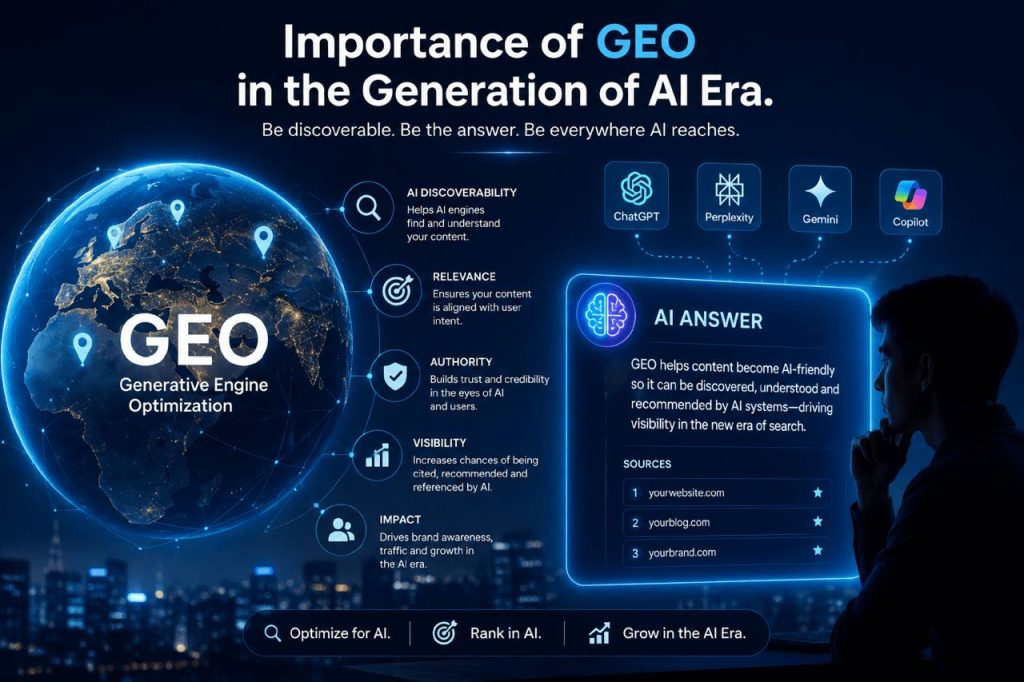
Why GEO Matters in the Generative AI Era?
The way people search for information online is changing faster than before. For decades, businesses focused on Search Engine Optimization (SEO) to improve rankings on traditional search engines. Today, the rise of Generative AI, AI-powered search, and intelligent AI answer engines is changing how users discover information online. Instead of browsing through multiple search results, users increasingly rely on AI-generated responses from chatbots, virtual assistants, and conversational search platforms.
This is exactly where Generative Engine Optimization (GEO) comes in as a new and necessary discipline. GEO focuses on optimizing content so that it can be effectively discovered, understood, and cited by AI systems. As Large Language Models (LLMs) become central to information retrieval, businesses and content creators must adapt their strategies to maintain visibility and authority.
The rapid growth of Generative AI technologies has fundamentally changed how people access information. Modern users expect immediate, conversational, and context-aware answers to their questions. Platforms powered by Large Language Models (LLMs) can synthesize information from multiple sources and provide direct responses instead of simply displaying links. This is a fundamental shift in how information is consumed and how brands need to show up online.
This means content creators can no longer rely solely on SEO rankings. A strong GEO marketing approach helps businesses remain visible where users are increasingly spending their time, inside AI-driven search environments. Companies that fail to optimize for AI-generated responses risk losing visibility even if they maintain strong traditional search rankings. In today’s digital world, being present in AI-generated answers is just as important as ranking on page one of Google.
AI Tools That Are Changing How We Search
The rise of GEO is closely connected to the growing use of AI tools that people now use daily to find information, get answers, and make decisions. These tools are no longer just experimental. They are mainstream and replacing traditional search habits for millions of users worldwide. Understanding these tools is the first step toward optimizing your content for them.
ChatGPT by OpenAI
ChatGPT is one of the most widely used AI assistants in the world. It generates detailed, conversational answers without sending users to a list of links. People use it for everything from quick questions to in depth research, making it a major channel for content discovery.
Google Gemini
Google Gemini is integrated directly into Search and summarizes information from multiple sources in seconds. When someone searches on Google, Gemini often generates an AI overview at the top of the page before any traditional results appear. This makes it critical for your content to be structured in a way Gemini can understand and reference.
Microsoft Copilot
Microsoft Copilot is built into Bing and Microsoft 365, helping users search, write, and analyze information using AI. It is a powerful tool for both personal and professional use and is growing rapidly in adoption across businesses.
Perplexity AI
Perplexity AI gives direct answers with cited sources and is growing fast among researchers, students, and professionals who want accurate information quickly. It pulls from trusted content and surfaces the most relevant, well-structured sources.
Meta AI
Meta AI is integrated into WhatsApp, Instagram, and Facebook, making AI-generated answers accessible to billions of users inside the apps they already use every day. This brings AI-powered search directly into social conversations and everyday interactions.
For businesses and content creators, this means a main thing. If your content is not structured in a way that these AI tools can understand, reference, and cite, you are invisible to a huge and growing portion of your audience. GEO is what bridges that gap.
From SEO to GEO: How SEO Built the Foundation We Stand On
Before GEO existed, SEO was everything. And without SEO, GEO would not even be possible. The journey from traditional search optimization to Generative AI optimization was a gradual shift built on decades of learning and evolving. It did not happen overnight and not by any mistake.
In the early days of the internet, SEO was all about keywords. Stuff your page with the right words, get a few backlinks, and you would rank on Google. Over time, Google got smarter. Algorithm updates like Panda, Penguin, and Hummingbird forced businesses to focus on quality content, genuine authority, and real user experience. It was never just about rankings. It was about creating content that genuinely helps people. That shift in thinking became the backbone of everything that followed.
As voice search grew, marketers learned to write conversationally, target question-based queries, and structure content so that Google could pull it into featured snippets. That is exactly what GEO asks us to do today. The principles were already being set in motion long before AI search became mainstream.
When AI-powered search emerged, it did not start from scratch. It was trained on the same high-quality, well-structured, authoritative content that good SEO practices had been encouraging for years. Websites that had already built strong SEO, clear structure, and genuine authority were naturally the first ones AI systems started pulling answers from. So SEO did not just prepare us for GEO. SEO created the conditions that made GEO possible.
The ones who understand how SEO and GEO work together are already moving in the right direction. They are not abandoning SEO. They are expanding it, layering GEO on top of a strong SEO foundation, and making sure their content is visible whether someone searches on Google or asks ChatGPT.
How to Optimize Content for AI Search Engines
Effective AI search optimization requires a different mindset from traditional keyword-focused SEO. AI systems are designed to understand context and meaning rather than simply matching keywords. The goal is to create content that is genuinely useful, clearly structured, and easy for AI systems to interpret and reference.
Focus on User Intent
Create content that answers real questions clearly and actionably. Understand what your audience is actually trying to achieve and give them direct, helpful information that solves their problem.
Use Natural Language
Since AI systems process conversational queries, content should reflect how people naturally communicate. Avoid keyword stuffing and write the way your audience speaks and thinks.
Create Comprehensive Content
AI systems favour topics covered in depth. Detailed guides, expert insights, and thorough explanations are more likely to be referenced in AI-generated responses than thin or surface-level content.
Structure Information Clearly
Use headings and concise paragraphs to improve content accessibility and comprehension. Well-structured content is easier for AI systems to read, understand, and extract answers from.
These practices form the foundation of successful AI content optimization and should be built into every piece of content you create.
Best GEO Practices for Businesses
Organizations seeking to improve search visibility in AI should adopt a strong GEO strategy and commit to it consistently over time.
Develop Topical Authority
Publish multiple related pieces of content that demonstrate expertise and help AI systems identify you as a trusted source within your niche.
Maintain Content Accuracy
AI tools are designed to surface information that people can actually trust and rely on. Regularly reviewing and updating your content ensures it stays accurate and relevant in a fast-moving landscape.
Implement Structured Data
Structured data helps AI systems understand content relationships and extract information more effectively. It is one of the most underused but powerful tools in a GEO strategy.
Build Brand Credibility
Brands that consistently publish high quality content and demonstrate real expertise are more likely to be referenced by AI answer engines. Credibility is built over time through consistency and value.
Monitor AI Search Trends
The AI landscape evolves rapidly. Continuously evaluate your performance, track how AI tools are referencing content in your niche, and adapt your GEO strategy accordingly.
Improving Visibility in AI-Generated Answers
One of the primary goals of GEO is improving visibility in AI-generated answers. To achieve this, provide direct answers since AI systems extract concise explanations from content. Include contextual information with real examples and data to improve relevance and depth. Strengthen authority signals through expert authorship, citations, and credible sources that AI systems can trust. Cover related topics since semantic relevance helps AI systems understand the broader context of your content and improves overall discoverability across platforms.
The more your content aligns with what AI systems are looking for, the more likely it is to appear in the responses that your potential audience is already reading.
Conclusion
The rise of Generative AI has created a new era of digital discovery. SEO still matters, but relying on it alone is no longer enough in today’s AI-driven world. Businesses and content creators must embrace Generative Engine Optimization (GEO) to ensure their content remains visible and influential in AI-driven ecosystems.
By implementing a strong GEO strategy, improving search visibility in AI, and building authority for AI-powered search, organizations can secure a competitive advantage in the evolving digital landscape. As Large Language Models (LLMs), AI assistant and AI answer engines become increasingly central to information access, GEO will play a critical role in determining which brands and creators succeed in the future of search.
For more details on digital marketing, visit omit.in
By: Ayesha Daniya.